 Baking Great Bread at Home
The Recipe That Lets Time Do the Work
IntermediateOvernight FrenchBread
by Henry Hunter Jr.
Two shapes, one foolproof method, real bakery flavor
Fermentation
10-14 hours
Bake Time
25-30 minutes
Yield
2 batards or 2 boules

Perfection is not required
"Great bread isn't about perfect technique—it's about understanding the dough."— Henry Hunter Jr.
By Henry Hunter Jr., founder of Crust & Crumb Academy and Baking Great Bread at Home.
Authentic Flavor
Most French bread recipes promise bakery results in 90 minutes. They lie. Not about the time, but about the flavor. Real French bread gets its character from , and fermentation takes time. This recipe bridges the gap between 'throw it together fast' and 'spend your whole weekend on baguettes.' You'll mix a simple before bed, wake up to a bubbling preferment, and pull golden loaves from your oven by lunch.
Equipment Needed
Ingredients
Poolish (Night Before)
This preferment develops flavor while you sleep
Final Dough
Mixed the next morning with the fermented poolish
Pro Tip
This is a wetter dough than most beginners expect. Wet hands for sticky dough. The stickiness becomes manageable after the s.
Day 1
Make the Poolish
The is where all the magic happens. During those 8-12 hours, the yeast produces organic acids, alcohols, and aromatic compounds that straight-dough methods can't replicate.
Click each step to mark complete
Add water
Add cool water to a medium bowl or container with a lid.
Add yeast
Sprinkle the tiny pinch of over the water. Don't overthink the measurement. It's basically 'barely any yeast.'
Add flour and mix
Add the flour and stir with a fork or spatula until no dry flour remains. It will look like thick pancake batter.
Cover and rest overnight
Cover loosely and leave at room temperature overnight (8-12 hours). If your kitchen is warm (above 75°F), use slightly cooler water or find a cooler spot.
Now
8-12 hours
Let it ferment overnight while you sleep
Day 2
Mix the Dough
About 30 minutes active time
The technique (resting the flour and water before adding salt) develops without heavy kneading. This is what makes the recipe accessible for anyone.
Click each step to mark complete
Combine poolish and water
Pour the warm water into a large mixing bowl. Add all of the and stir to dissolve it into the water. It doesn't need to be perfectly smooth.
Add flour and yeast
Add the flour and yeast. Mix with a stiff spatula or your hand until you have a shaggy mass with no dry flour visible.
Fermentolyse rest
Let this rest for 20-30 minutes. This is not optional. The flour hydrates and gluten begins developing without any work from you.
Add salt
Sprinkle the salt over the dough. Using wet hands, squeeze and fold the dough until the salt is fully incorporated.
Initial mix
Continue folding and squeezing for 2-3 minutes. The dough will feel sticky and shaggy. That's normal.
⏱ Wait Time
Let the dough rest (fermentolyse) before adding salt
Pro Tip
Don't skip the fermentolyse rest. Those 20-30 minutes do more for your gluten development than 10 minutes of kneading.
Precise Timers
Use these interactive timers to track your stages.
Fermentolyse Rest
Salt Incorporation
Day 2
Bulk Fermentation
2-3 hours with stretch and folds
is where the dough builds strength and develops flavor. The technique replaces traditional kneading.
Click each step to mark complete
First fold (30 min)
With wet hands, grab one side of the dough, stretch it up, and fold it over to the other side. Rotate the bowl 90° and repeat. Do this 4 times (all four sides). Cover.
Second fold (60 min)
Repeat the process. The dough should already feel smoother and more elastic.
Third fold (90 min)
One more set of folds. By now, the dough should feel pillowy and hold its shape better.
Let it rise
After the third fold, let the dough rise undisturbed until it has grown 50-75% and looks puffy with visible bubbles. This takes 1-2 more hours depending on temperature.
⏱ Wait Time
Build strength through folds, then let it rise
Pro Tip
Watch the dough, not the clock. The dough is ready when it has grown significantly, jiggles when you shake the bowl, and you can see bubbles on the surface and sides.
Precise Timers
Use these interactive timers to track your stages.
First Fold
Second Fold
Third Fold
Final Rise
Shaping
Shaping
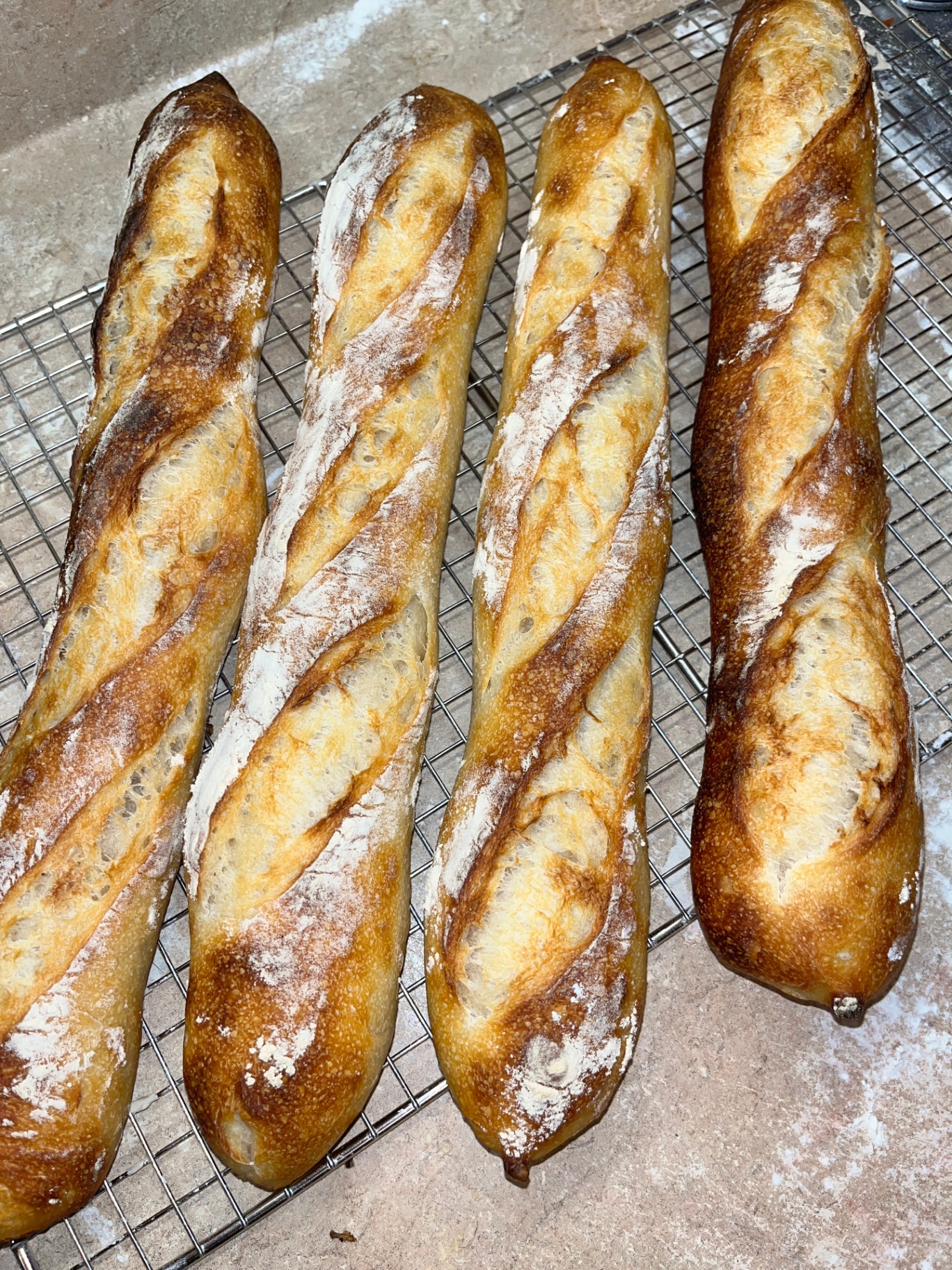
You have two options: (oval) or (round). The batard is my go-to for this recipe because it slices beautifully for sandwiches.
Batard (Oval Loaf)
The classic French shape. Yields beautiful slices perfect for sandwiches or toast.
RecommendedClick each step to mark complete
Divide the dough
Flour your work surface lightly. Turn out the dough and divide it in half using a . Each piece should be roughly 450g.
Pre-shape
Working with one piece, gently gather the edges toward the center, creating a rough round. Flip it seam-side down. Let it rest 15-20 minutes uncovered ().
Final shape
Flip the dough seam-side up. Fold the bottom third up and the top third down (like a letter). Then roll it gently from top to bottom, sealing the seam with your fingertips.
Build tension
Cup your hands around the dough and gently rock it back and forth to create a torpedo shape with tapered ends.
Place on baking sheet
Place seam-side down on a parchment-lined baking sheet. Repeat with the second piece.
Final proof
Cover loosely with plastic wrap or a damp towel and let for 45-60 minutes until puffy but not doubled.
Boule (Round Loaf)
The works well if you're baking in a . The round shape fits perfectly and you get incredible .
Click each step to mark complete
Divide the dough
Flour your work surface lightly. Turn out the dough and divide it in half.
Gather and shape
Working with one piece, gather the edges and pull them toward the center, creating tension on the bottom (which will become the top).
Build surface tension
Flip the dough over so the smooth side faces up. Cup your hands around the dough and drag it toward you on the counter, using the friction to build surface tension. Rotate slightly and repeat until you have a taut round.
Place for proofing
Place seam-side down on parchment (for baking sheet) or seam-side up in a floured (if using Dutch oven).
Final proof
Cover loosely and proof for 45-60 minutes.
Proof Test: The : Gently poke the dough with a floured finger. If it springs back slowly and leaves a slight indent, it's ready. If it springs back fast, give it more time.
The Final Step
Baking
Two methods, both excellent. The traps steam automatically. The baking sheet method uses ice cubes for steam.
Baking Methods
Great for batards or when baking multiple loaves at once
Equipment: Baking sheet, metal pan for steam
Preheat with steam pan
Preheat your oven to 475°F (245°C) with a rack in the center and an empty metal pan on the bottom rack.
Score the loaves
the loaves with a or sharp knife. For batards, make one long slash down the center or 3-4 diagonal slashes. Score about 1/4 inch deep at a 45-degree angle.
Load and create steam
Slide the baking sheet into the oven. Immediately throw 4-5 ice cubes onto the hot pan below and close the door quickly. The steam is essential for development.
Bake with steam
Bake for 10 minutes with steam, then remove the pan with ice (carefully, it's hot).
Finish baking
Continue baking for 15-20 minutes until the crust is deep golden brown and the internal temperature reaches 205-210°F (96-99°C).
Cool completely
Let cool on a wire rack for at least 30 minutes before slicing. I know it's hard. The bread is still cooking inside.
Nutrition Facts
Per 1 slice (about 60g) • 16 servings per recipe
* Values are estimates based on standard ingredients
Storage
Room Temperature
2-3 days in a paper bag or wrapped in a clean towel. Avoid plastic, which traps moisture and softens the crust.
Refrigerated
Not recommended. Refrigeration accelerates staling.
Frozen
Up to 3 months. Slice before freezing so you can pull individual slices as needed.
Refresh
Toast slices directly from frozen, or warm a whole loaf at 350°F (175°C) for 10-12 minutes.
Your Feedback
Rate This Recipe
Loading ratings...
Troubleshooting
Baker's Notes
Common questions and solutions for perfect results
If you're serious about scoring, you need the right blade in your hand. Wire Monkey makes handcrafted bread lames from black walnut — built to last, balanced in the hand, and sharp enough to glide through cold dough cleanly every single time. No dragging, no hesitation marks. Just a clean cut.
Wire Monkey Handcrafted Bread Lames
You Might Also Enjoy
More recipes from our pantry that pair well with this bake.
Get More Recipes in Your Inbox
Join thousands of home bakers receiving weekly recipes, tips, and techniques to elevate your bread game.
No spam, ever. Unsubscribe anytime.
More from Baking Great Bread at Home
Tools, resources, and community to help you bake better bread

Crust & Crumb Academy
Go deeper into your craft. FREE courses, challenges, and real feedback. No gatekeeping. Perfection is not required.
Sourdough Starter Companion
Your AI-powered starter assistant. Track feedings, troubleshoot issues, and keep your starter thriving.

BakingGreatBread.com
Real bread for the rest of us

Baking Great Bread Blog
Recipes, tips, and stories from the bread journey
Recipe Converter
Convert sourdough recipes to yeast and back again
Crust & Crumb App
Your AI-powered baking assistant

Facebook Community
Join 50,000+ bakers sharing, learning, and supporting each other

Sourdough for the Rest of Us
Free beginner's guide to sourdough